it has been some three weeks since this page posted a bit called 'rich hill in context', which made a point of trying to highlight just how special the four-season minor league career of hill had been -- particularly since 2005 -- as a vehicle by which to lobby you, dear reader, for forbearance as hill found his way early in his major league career. of course, that bit had been preceded by earlier ones -- here and here and here and even going back to 2005 here and here -- pointing up just how much more this page considered hill to be worthy of the extended opportunity to prove his mettle than many of his peers in the cub farm system.
the cubs and their fans have been equally guilty in the past of passing summary judgment (both for and against) on either far too little or deeply misconstrued data, knowledge and understanding. such irrational judgment was approaching hill from many influential but unknowledgable and immoderate quarters even before a sensible handful of major league innings had been pitched (indeed, as soon as the aftermath of his first appearance on a major league field). and it, at least in the view of this page, thankfully did not carry the day.
but what this page attempted to express in words was always going to be much better expressed if it could be by rich hill himself in innings pitched at the major league level -- and he has thankfully seized the opportunity (thusfar) to do exactly that.
including and since his start of august 1, hill has posted in eight appearances (seven of which were starts) 50 innings of 2.70 era baseball, allowing just 36 hits and 14 walks for a 1.00 whip, .193 baa and .253 obpa, along with 45 strikeouts. he's arguably been the cubs best starter since the all star break, bettering zambrano in era, obpa and opsa. and of the 35 rookie pitchers in baseball since the break who have made more than five starts, hill ranks 9th in era (3.21) in a list that constitutes a who's-who of blue-chip pitching prospects.
the latest installment, coming last night, may prove to be the highwatermark for some time to come. hill moved through the impatient pittsburgh side, fanning 11 over 7.1 innings and 111 pitches, while allowing just seven baserunners, one of which was the result of a dropped third strike. this page noted again the ability of hill to respond to trouble, always a sign of a good pitcher. this time, in the first when leadoff hitter chris duffy walked on four pitches to open the game, hill reacted by striking out the side, including jason bay and national league batting leader freddy sanchez. but it wasn't again until the eighth that hill found trouble again, when, following a juan castillo single to open the frame, the cubs infield were unable to field pinch-hitter jack wilson's well-executed but expected bunt, leaving hill to field the ball late and make an errant throw, tying the game 1-1.
yet another ronny cedeno error -- who now, at .951, has the worst fielding percentage of anyone in baseball with more than 350 chances -- put hill in a position to take the loss in spite of it. but he was rescued from that fate by derrek lee's eighth-inning grand slam (oh, how we've missed you, sir) that put the game in the cubs' hands and elevated them -- at least temporarily -- over the pirates in the central.
to be sure, hill is not perfect -- his delivery to the plate is slow and he is particularly susceptible to the stolen base for a lefthander, and he is a flyball pitcher who lives and dies upstairs with a rising fastball. that kind of pitcher will always surrender a higher amount of runs than one might like, because runners will run into scoring position more often than normally and hitters will hit mistakes into the stands with alarming frequency. pairing him with a strong-armed catcher may be of great interest.
and this page, for one, doesn't think hill is going to mount a sub-3 earned run average for whole seasons -- what he has done lately has been brilliant, but there will be bad days too.
however, it is here hoped that the minimum of what can now be said is that hill has proved his promise and deserves -- in his own best interests, but more importantly the cubs' -- to be in the starting rotation in 2007. moreso than sean marshall, moreso than angel guzman, moreso than mark prior (upon whom nothing can be relied for next season), and moreso than juan mateo (another cubs pitcher that this page regards and has regarded highly), rich hill should be taking the mound in regular turns next season in order to capitalize upon and flesh out the development we all have seen from him this year. and it is up to jim hendry to make sure it happens.
Thursday, September 07, 2006


Wednesday, September 06, 2006
In a nutshell
As the 2006 season moves toward completion it's looking more and more like the Chicago Cubs will do what this writer predicted and few believed, reach the 100 loss plateau. The question becomes how does an organization with all the advantages of the top teams in baseball become the worst team in the National League?
Well, all you need to know about the Cubs organization you can learn from reading a round table discussionthat occurred this winter. Representing the Cubs, and by extention the baseball philosophical dinosaur-side of the discussion was Jim Hendry's right-hand man, Gary Hughes.
I encourage you to read the discussion it is VERY eye-opening.
The basic premise of the discussion was how the various teams value certain types of talent, and by extention certain types of players. The article discusses the "Moneyball" concept choosing college pitchers over high school pitchers if the ability-levels are anywhere near equitible, because college pitchers have skill-sets (and bodies) that are much easier to predict a success-level as a professional.
The discussion covers various other topics, but the real reason I bring it up is just to highlight the dichotomy in baseball general management that still exists and is the main reason why the Cubs find themselves in last place in the worst division in baseball.
The player who represents all that is wrong with MacPhail/Hendry player valuation is centerfielder Juan Pierre. Many in the Cub Blogosphere have been calling for Juan Pierre to be given a long-term free agent contract following the season for such reasons as; "How long did it take us to find a lead off hitter?" or "Felix Pie is just the next Corey Patterson", or "Since the All-Star break his average has been great" or my personal favorite, "He's got 49 stolen bases do you know how valuable that is?"
Well let me tell you how valuable that is.
As of September 06, Juan Pierre has 127 singles, 30 doubles, 12 triples, 2 homeruns, 49 stolen bases, 19 caught stealing, 1 sacrifice fly, 32 bases on balls, 8 hit-by-pitch, and 589 At-Bats - this gives him a nominal OBP of .3349 ([H+BB+HBP]/[AB+SF+BB+HBP]) and a nominal SLG of .3922 (TB/AB), giving Pierre a nominal OPS of .727 (ugh)
But wait folks that's not all.
Because Pierre is such an inefficient stealer of bases, his value is decreased even further. A caught stealing is in effect a reduction of a "success" at the plate, therefore the adjusted OBP formula becomes ([H+BB+HBP-CS]/[AB+SF+BB+HBP]). Juan Pierre's adjusted OBP is .3063.
To be completely fair, Juan Pierre's stolen base successes DO increase his nominal SLG. The adjusted SLG formula is ([TB+SB]/AB), giving Pierre an adjusted SLG% of .4754.
A "quick and dirty" formula to measure offensive value is "Runs Created" which is nothing more than OBP*TB, however if the two "adjusted" metrics are substituted for the nominal metrics (OBP and SLG) the statistic becomes more valuable (more statistically significant to run creation).
That being said, Juan Pierre currently has an adjusted Runs Created of 85.777 (.3063*280). To put that in context with the rest of the league's centerfielders I compared Pierre's performance with the league's 50 outfielders who qualify for the batting title (3.1 ABs/G). Below is the result of the analysis, however keep in mind Runs Created is a counting statistic and Juan Pierre leads MLB in ABs so his opportunities to create runs are higher in proportion to his ABs.
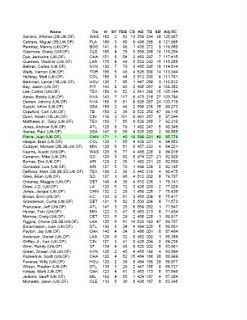
Juan Pierre is an AVERAGE offensive outfielder, when you consider his 2.21 RF (slightly better than average) and AWFUL throwing arm his defense can only be judged as average/below average.
All in all, Juan Pierre COULD be a useful player for a team like the Red Sox/Yankees/Mets that could bat him 7 or 8 in the lineup, however to a team like the Chicago Cubs, Juan Pierre's skillset/price tag make absolutely NO SENSE for the current state of the team. Even moreso when you consider, the organization has a player in AAA in Felix Pie that will produce at a Pierre-like VORP, given the opportunity, in 2007 for $330,000.
If you are one this unfortunate souls who still retain your season tickets to this sad-sack franchise, Juan Pierre will provide you with a leading indicator to whether or not the Organization has learned from its mistakes.
It's as simple as this, if Juan Pierre is signed to anything more than a 1-year contract for $4-5 million for '07 you can safely "lose" your renewal forms. That'll tell you right there, this team STILL DOESN'T GET IT.
Well, all you need to know about the Cubs organization you can learn from reading a round table discussionthat occurred this winter. Representing the Cubs, and by extention the baseball philosophical dinosaur-side of the discussion was Jim Hendry's right-hand man, Gary Hughes.
I encourage you to read the discussion it is VERY eye-opening.
The basic premise of the discussion was how the various teams value certain types of talent, and by extention certain types of players. The article discusses the "Moneyball" concept choosing college pitchers over high school pitchers if the ability-levels are anywhere near equitible, because college pitchers have skill-sets (and bodies) that are much easier to predict a success-level as a professional.
The discussion covers various other topics, but the real reason I bring it up is just to highlight the dichotomy in baseball general management that still exists and is the main reason why the Cubs find themselves in last place in the worst division in baseball.
The player who represents all that is wrong with MacPhail/Hendry player valuation is centerfielder Juan Pierre. Many in the Cub Blogosphere have been calling for Juan Pierre to be given a long-term free agent contract following the season for such reasons as; "How long did it take us to find a lead off hitter?" or "Felix Pie is just the next Corey Patterson", or "Since the All-Star break his average has been great" or my personal favorite, "He's got 49 stolen bases do you know how valuable that is?"
Well let me tell you how valuable that is.
As of September 06, Juan Pierre has 127 singles, 30 doubles, 12 triples, 2 homeruns, 49 stolen bases, 19 caught stealing, 1 sacrifice fly, 32 bases on balls, 8 hit-by-pitch, and 589 At-Bats - this gives him a nominal OBP of .3349 ([H+BB+HBP]/[AB+SF+BB+HBP]) and a nominal SLG of .3922 (TB/AB), giving Pierre a nominal OPS of .727 (ugh)
But wait folks that's not all.
Because Pierre is such an inefficient stealer of bases, his value is decreased even further. A caught stealing is in effect a reduction of a "success" at the plate, therefore the adjusted OBP formula becomes ([H+BB+HBP-CS]/[AB+SF+BB+HBP]). Juan Pierre's adjusted OBP is .3063.
To be completely fair, Juan Pierre's stolen base successes DO increase his nominal SLG. The adjusted SLG formula is ([TB+SB]/AB), giving Pierre an adjusted SLG% of .4754.
A "quick and dirty" formula to measure offensive value is "Runs Created" which is nothing more than OBP*TB, however if the two "adjusted" metrics are substituted for the nominal metrics (OBP and SLG) the statistic becomes more valuable (more statistically significant to run creation).
That being said, Juan Pierre currently has an adjusted Runs Created of 85.777 (.3063*280). To put that in context with the rest of the league's centerfielders I compared Pierre's performance with the league's 50 outfielders who qualify for the batting title (3.1 ABs/G). Below is the result of the analysis, however keep in mind Runs Created is a counting statistic and Juan Pierre leads MLB in ABs so his opportunities to create runs are higher in proportion to his ABs.
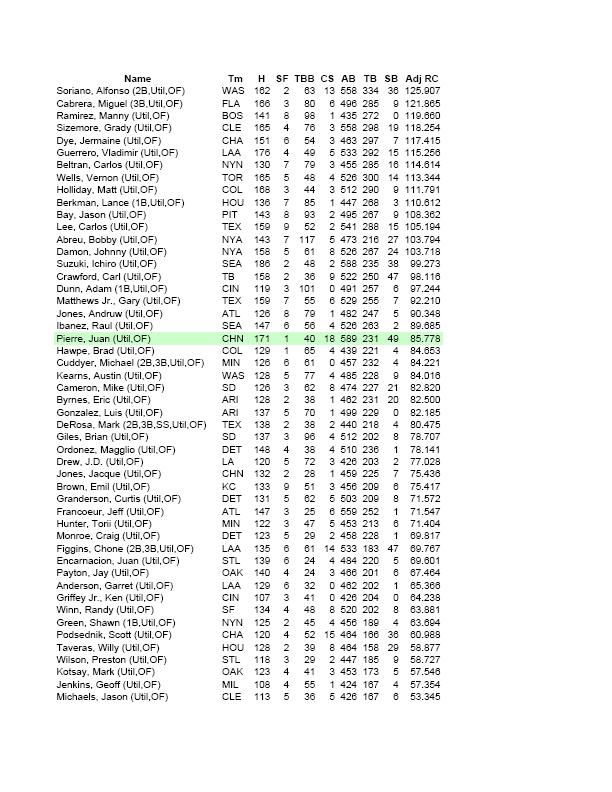
Juan Pierre is an AVERAGE offensive outfielder, when you consider his 2.21 RF (slightly better than average) and AWFUL throwing arm his defense can only be judged as average/below average.
All in all, Juan Pierre COULD be a useful player for a team like the Red Sox/Yankees/Mets that could bat him 7 or 8 in the lineup, however to a team like the Chicago Cubs, Juan Pierre's skillset/price tag make absolutely NO SENSE for the current state of the team. Even moreso when you consider, the organization has a player in AAA in Felix Pie that will produce at a Pierre-like VORP, given the opportunity, in 2007 for $330,000.
If you are one this unfortunate souls who still retain your season tickets to this sad-sack franchise, Juan Pierre will provide you with a leading indicator to whether or not the Organization has learned from its mistakes.
It's as simple as this, if Juan Pierre is signed to anything more than a 1-year contract for $4-5 million for '07 you can safely "lose" your renewal forms. That'll tell you right there, this team STILL DOESN'T GET IT.
Tuesday, September 05, 2006
the abandonment
one of the more vivid memories of this cub fan is, strangely enough, april 1997.
the cubs had been tepid at best for years at that point, with the last whiff of competitiveness some eight seasons distant. zimmer and dallas green had long since been canned, lefebvre came and went, the well-intentioned tom trebelhorn laughed out of town, and the beat of mediocrity kept pounding out under the strangely effeminate "tough guy" manager, jim riggleman. the cubs had resolved the bullpen-by-bad-committee of 1996 by obtaining montreal closer mel rojas, looked forward to another great year from developing 26-year-old steve trachsel to back horse jaime navarro, had young superprospect kevin orie coming in to take third and one-time superprospect shawon dunston coming back to man short. that passed for promise around here in 1997.
so it was perhaps not a surprise to everyone when the cubs started losing out of the gate -- but being swept on the road and outscored 36-16 in both of the first two series was a bit of a shock, even if those two teams were among the class of the national league. the cubs limped home 0-6 for the opener in chicago -- only to face the marlins and braves again -- and shiny new closer rojas had already coughed up four runs in two appearances. their response to this adversity was to score eight runs in the next four, running their record to 0-10 with colorado coming into town for two before they were to head to new york.
by this time, harry caray's downtown was serving taps of budweiser for 45 cents or something -- in honor of the last pennant year, if beclouded memory serves -- and this writer and his good friends ccd and vehere were partaking with gusto. it wasn't even tax day yet, and the season was already over. isn't that reason enough to drink? it seemed so then, anyway.
we had gone to the home opener, as was then our tradition, only to see the marlins score two in the seventh and another in the ninth (which none of us remeber, to be sure) to ice it. it's always hard to get a read on cubdom at the opener -- even then, scads of people showed up just to get hammered. and we went to some more april games after that, including the 12th straight loss, when real rational hope for a win rested on someone named roger bailey, the rockies unspectacular starter. but the rational does not account for the humour of the gods, and bailey ended up tossing a complete-game five-hitter without a strikeout.
but the game -- the one that stuck in this writer's head -- was april 24. the cubs had run it out to 0-14 before netting two wins in new york to salvage a road split and ending the cheap beer, then traveled to montreal for the honor of losing two more. at 2-16, the cubs came home to try to stem the bleeding in a six-game homestand, starting with pittsburgh and francisco cordova.
scenes from that frigid night, for whatever reason, have stuck in this writer's head as though captured in photographs. trachsel pitched brilliantly for one of the last times that year, and the cubs touched up the pirate bullpen for a couple to take a 3-2 lead into the ninth. rojas had come on to end the eighth, and re-emerged from the dugout to seal the win.
except that he didn't, of course -- taking instead another large step in the direction of new york, to whom he would be traded in disgrace later that season. a leadoff single and passed ball put a man in scoring position, which didn't seem so bad when rojas got two outs. but jason kendall then doubled to tie the game and the inexorable weight of losing that always presses down on a bad team, ready to lever any momentary weakness to crush hope instantaneously, found a trigger in a jose guillen single.
but what is remembered best is the frighteningly sparse crowd. it was a cold april night, and the cubs were godawful losers -- and, it must be remembered, this was 1997. this was before the sammy steroid show, before the kerry wood 20-strikeout game, before the mark prior hype machine, before 1998, before 2003. the cubs were still ryne sandberg's team in 1997, despite his declining skills, trapped in a sport recovering from a devastating strike in 1994. the marketing engine that soon turned wrigley into chicago's win-or-lose beer garden of choice was still in first gear. the announced crowd was about twenty thousand -- but if there were a quarter of that number in the park, this writer would be surprised. you could've sat anywhere in the park and had the section virtually to yourself, it seemed. such were the wages of constant and painful futility.
fast forward to tonight, a clear and pleasant september evening of the tuesday following labor day, and again old wrigley reminds this writer of that distant april -- pittsburgh in the field against them as they battle the relentless negative momentum that is part and parcel to being a bona fide loser in front of such a scarcity of people that it seems no one is in the stands at all. huge expanses of empty seats stretch out behind the plate and even in the bleachers, which probably haven't been so uncrowded for any game since 1997. who knows what the announced attendance will be, but if there are much more than ten thousand people at wrigley tonight this writer would be surprised.
it's the tuesday after labor day, the kids are back in school, the pirates are horrid -- a number of mitigating excuses can be found. but this writer for one thinks that the tribune company should take a closer look at what the golden goose could look like if allowed to be strangled by andy macfail and jim hendry for much longer. the cubs aren't likely going to be any good at all in 2007 either, and just across town a younger and impressionable generation is learning to love winning baseball.
consider it a warning, tribco. for the long-term good of the franchise, something needs to be done.
the cubs had been tepid at best for years at that point, with the last whiff of competitiveness some eight seasons distant. zimmer and dallas green had long since been canned, lefebvre came and went, the well-intentioned tom trebelhorn laughed out of town, and the beat of mediocrity kept pounding out under the strangely effeminate "tough guy" manager, jim riggleman. the cubs had resolved the bullpen-by-bad-committee of 1996 by obtaining montreal closer mel rojas, looked forward to another great year from developing 26-year-old steve trachsel to back horse jaime navarro, had young superprospect kevin orie coming in to take third and one-time superprospect shawon dunston coming back to man short. that passed for promise around here in 1997.
so it was perhaps not a surprise to everyone when the cubs started losing out of the gate -- but being swept on the road and outscored 36-16 in both of the first two series was a bit of a shock, even if those two teams were among the class of the national league. the cubs limped home 0-6 for the opener in chicago -- only to face the marlins and braves again -- and shiny new closer rojas had already coughed up four runs in two appearances. their response to this adversity was to score eight runs in the next four, running their record to 0-10 with colorado coming into town for two before they were to head to new york.
by this time, harry caray's downtown was serving taps of budweiser for 45 cents or something -- in honor of the last pennant year, if beclouded memory serves -- and this writer and his good friends ccd and vehere were partaking with gusto. it wasn't even tax day yet, and the season was already over. isn't that reason enough to drink? it seemed so then, anyway.
we had gone to the home opener, as was then our tradition, only to see the marlins score two in the seventh and another in the ninth (which none of us remeber, to be sure) to ice it. it's always hard to get a read on cubdom at the opener -- even then, scads of people showed up just to get hammered. and we went to some more april games after that, including the 12th straight loss, when real rational hope for a win rested on someone named roger bailey, the rockies unspectacular starter. but the rational does not account for the humour of the gods, and bailey ended up tossing a complete-game five-hitter without a strikeout.
but the game -- the one that stuck in this writer's head -- was april 24. the cubs had run it out to 0-14 before netting two wins in new york to salvage a road split and ending the cheap beer, then traveled to montreal for the honor of losing two more. at 2-16, the cubs came home to try to stem the bleeding in a six-game homestand, starting with pittsburgh and francisco cordova.
scenes from that frigid night, for whatever reason, have stuck in this writer's head as though captured in photographs. trachsel pitched brilliantly for one of the last times that year, and the cubs touched up the pirate bullpen for a couple to take a 3-2 lead into the ninth. rojas had come on to end the eighth, and re-emerged from the dugout to seal the win.
except that he didn't, of course -- taking instead another large step in the direction of new york, to whom he would be traded in disgrace later that season. a leadoff single and passed ball put a man in scoring position, which didn't seem so bad when rojas got two outs. but jason kendall then doubled to tie the game and the inexorable weight of losing that always presses down on a bad team, ready to lever any momentary weakness to crush hope instantaneously, found a trigger in a jose guillen single.
but what is remembered best is the frighteningly sparse crowd. it was a cold april night, and the cubs were godawful losers -- and, it must be remembered, this was 1997. this was before the sammy steroid show, before the kerry wood 20-strikeout game, before the mark prior hype machine, before 1998, before 2003. the cubs were still ryne sandberg's team in 1997, despite his declining skills, trapped in a sport recovering from a devastating strike in 1994. the marketing engine that soon turned wrigley into chicago's win-or-lose beer garden of choice was still in first gear. the announced crowd was about twenty thousand -- but if there were a quarter of that number in the park, this writer would be surprised. you could've sat anywhere in the park and had the section virtually to yourself, it seemed. such were the wages of constant and painful futility.
fast forward to tonight, a clear and pleasant september evening of the tuesday following labor day, and again old wrigley reminds this writer of that distant april -- pittsburgh in the field against them as they battle the relentless negative momentum that is part and parcel to being a bona fide loser in front of such a scarcity of people that it seems no one is in the stands at all. huge expanses of empty seats stretch out behind the plate and even in the bleachers, which probably haven't been so uncrowded for any game since 1997. who knows what the announced attendance will be, but if there are much more than ten thousand people at wrigley tonight this writer would be surprised.
it's the tuesday after labor day, the kids are back in school, the pirates are horrid -- a number of mitigating excuses can be found. but this writer for one thinks that the tribune company should take a closer look at what the golden goose could look like if allowed to be strangled by andy macfail and jim hendry for much longer. the cubs aren't likely going to be any good at all in 2007 either, and just across town a younger and impressionable generation is learning to love winning baseball.
consider it a warning, tribco. for the long-term good of the franchise, something needs to be done.
Subscribe to:
Posts (Atom)